Overview#
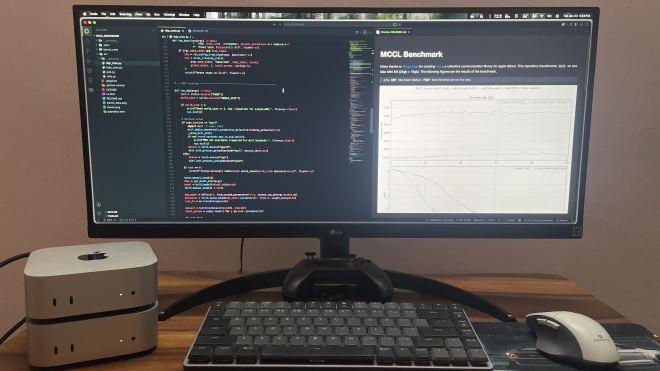
Collective Communication Libraries such as nccl for nvidia gpus, rccl for amd gpus and xccl for intel gpus have enabled to scale up training of deep learning models to multiple gpu clusters. For apple gpus however, there exists jaccl but is exclusively for the MLX Framework. There was no way to use PyTorch DDP on Apple Silicon, up until the developers at mps-ddp had created and graciously open-sourced mccl. The rest of the blog is a guide to do distributed training with PyTorch DDP on MCCL. All you need are two Macs and a Thunderbolt 4/5 cable.
Code Migration#
The changes to transition your PyTorch code into DDP code can be split into:
- Set up process groups.
import torch
import torch.distributed as dist
from torch.nn.parallel import DistributedDataParallel as DDP
from torch.utils.data import Dataloader
from torch.utils.data.distributed import DistributedSampler
import mccl

def setup():
    rank = int(os.environ["RANK"])
    world_size = int(os.environ["WORLD_SIZE"])
    device = torch.device("mps:0")

    # use this when using thunderbolt connection
    mccl.apply_thunderbolt_production_defaults(training_defaults=True)
    dist.init_process_group(backend="mccl", device_id=device)
- Initialise the model and dataloader.
def init_model():
    dataset = build_dataset()
    dataloader = Dataloader(dataset=dataset,
        batch_size=32,
        shuffle=False,  # We don't shuffle
        sampler=DistributedSampler(dataset), # DistributedSampler shuffles
    )

    model = build_model().to(device)
    ddp_model = DDP(model, **kwargs)

    optimizer = torch.optim.AdamW(ddp_model.parameters(), lr=1e-3)
    loss_fn = nn.CrossEntropyLoss()
- Cleanup after training.
def cleanup():
    dist.destroy_process_group()
The env variables RANK and WORLD_SIZE will be set by torchrun when you run:
# Run on Mac 0 (Master Node):
torchrun --nproc_per_node=1 --nnodes=2 --node_rank=0 \
    --master_addr=169.254.x.x --master_port=29500 \
    train.py

# Run on Mac 1 (Worker Node):
torchrun --nproc_per_node=1 --nnodes=2 --node_rank=1 \
    --master_addr=169.254.x.x --master_port=29500 \
    train.py
The master_addr is the IP address of the Thunderbolt connection on the master node.
no_sync context provided by PyTorch DDP, to accumulate the gradients for multiple epochs before synchronizing and updating the parameters.Performance Tuning#
All of these are read at ProcessGroup init. Defaults come from mccl/config.py unless overridden.
Transport / networking#
| Var | Default | When to override |
|---|---|---|
| MCCL_TRANSPORT | auto | Force tcp or rdma if RDMA is configured |
| MCCL_LISTEN_ADDR | auto | Multi-host: bind address; localhost auto-set for local runs |
| MCCL_PORT_BASE | 29600 | Firewall/port conflicts |
| MCCL_IFNAME | "" | Multi-homed Mac picking wrong interface |
| MCCL_CHUNK_BYTES | 4 MB | Large transfers; TB profile bumps to \ge 16 MB if unset |
| MCCL_SMALL_MSG_THRESHOLD | 256 KiB | Algorithm thresholds for small vs large messages |
| MCCL_CONNECT_TIMEOUT_MS | 30000 | Slow/unreliable links |
| MCCL_SOCK_BUFSIZE | 32 MB (large default) | Set 0 for kernel auto-tune; TB profile uses 32 MB |
| MCCL_TCP_LOWAT | 131072 | macOS TCP throughput tuning |
| MCCL_LINK_PROFILE | unset | Set thunderbolt for TB Mac-to-Mac TCP |
| MCCL_TRANSPORT_CRC | off | Debug corrupted transfers |
Compute / GPU sync#
| Var | Default | When to override |
|---|---|---|
| DDP_BUCKET_MB | 25 mb | Larger (e.g. 50–200) → fewer allreduces per step → fewer TCP round-trips over the inter-host link. Trade-off: memory / peak message size. |
| MCCL_SYNC_MODE | full (implicit) | Keep full for DDP. Never use coalesced with hook-driven multi-bucket DDP |
| MCCL_EVENT_SYNC | on | Set 0 to disable Metal event path (uses stream sync instead) |
| MCCL_OVERLAP_COMM | on | Overlap comm with GPU; needs event sync |
| MCCL_FAST_MATH | on | Metal kernel precision |
| MCCL_GPU_THRESHOLD | 4096 | When to use GPU vs CPU reduce |
| MCCL_FP32_CPU_REDUCE | off | Set 1 to force CPU vDSP fp32 reduce on UMA |
| MCCL_SHADER_PATH | auto | Dev / non-standard install layout |
| MCCL_ALLREDUCE_ALGO | unset | ring_chunked for large allreduce |
| MCCL_RING_ALGO | unset | chunked / ring_chunked / fast for ring path |
Compression#
| Var | Default | When to override |
|---|---|---|
| MCCL_COMPRESSION | none | fp16 or topk to cut wire bytes (validate stability) |
| FP16 training | TRAIN_AUTOCAST_FP16=1 in ddp_dummy_train.py (or your script) uses torch.autocast("mps", dtype=torch.float16) where supported. | |
| MCCL_TOPK_RATIO | 0.01 | When using topk compression |
Runtime / watchdog#
| Var | Default | When to override |
|---|---|---|
| MCCL_LOG_LEVEL | WARN | INFO/DEBUG for diagnostics |
| MCCL_WATCHDOG_TIMEOUT_MS | 300000 | Hung collective detection |
| MCCL_HEARTBEAT_INTERVAL_MS | 5000 | Transport keepalive |
| MCCL_MAX_QUEUE_DEPTH | 1024 | Backpressure tuning |
Configure many of these via Python instead:
mccl.init(compression="fp16", chunk_bytes=16*1024*1024)
setup()
See more at docs.
Conclusion#
I have benchmarked the performance on MCCL on my two-Mac setup and the results are quite remarkable. The details of the benchmark can be found in my github repo
benchmarking mccl on apple silicon
And, the github repo of MCCL
metal collective communication library (pytorch DDP)